

The Sham of Burmese Democracy: an Abuse by the Junta Regime
By Annabelle Kim, Research Fellow
Featured Photo Caption: A democratic activist protesting in 2021 against the military junta’s attempted coup. The fight is still going on 5 years later.
Photo Cred: Getty Images via BBC
Every September 15th, the world promises again and again to uphold the values of democracy. Yet, we must remind the world that human rights and the rule of law must be respected. We all have a duty to support the ongoing efforts for democracy in Burma. This year, on the International Day of Democracy, the man who destroyed Burma’s democracy is sitting in the presidential palace in Naypyidaw and is finding international patrons for his illegitimate governance.
It’s been five years since the People of Burma were given an empty promise from the military junta that the state of emergency would be lifted and that a democratic, peaceful, and equal country would come after elections. The voting did come. But the “promises” that preceded it did not. It was not an election for the People of Burma, but rather a way to transfer Min Aung Hlaing’s power from Senior General to President. The military junta never intended to follow through on democracy.
A Democratic Sham: the Method of Fake Votes
The junta’s staged election, held in three phases from December 28, 2025, to January 25, 2026, was never meant for the people of Burma. Voting happened in only 263 of 330 townships, and 67 could not hold elections at all. The junta’s alleged democratic elections were only held in the areas that they held control over. Further, they did not have legitimate democratic opposition. The National League for Democracy, which won the 2020 election in a landslide, had been dissolved in 2023 by the military junta's election commission.
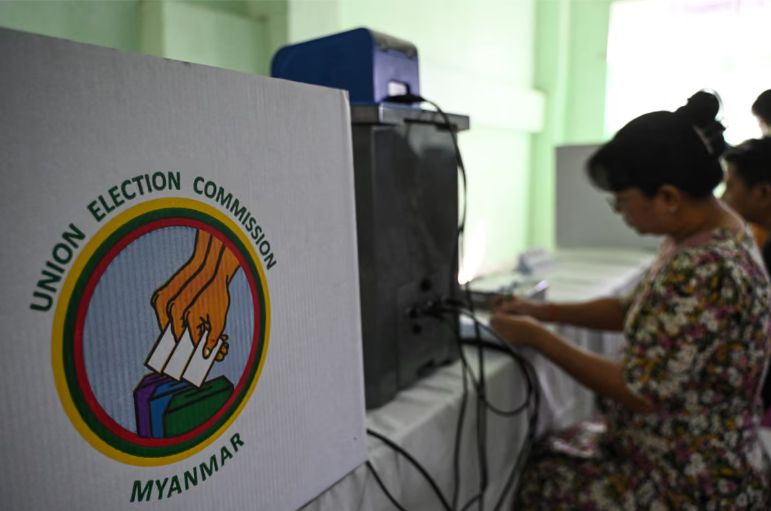
When citizens are haunted with fear when casting their votes due to a military presence, that is not democracy: no matter how much the junta denies it, they are not the representatives to Burma.
Photo: Nhac Nguyen/AFP/Getty Images via The Guardian
The electoral process was clearly not a legitimate one, but even worse is that as the ballots were being counted, the bombs kept falling. The UN documented at least 702 civilian deaths between the time period when the election was announced and when voting closed. The Assistance Association for Political Prisoners (AAPP) has verified 7,636 people killed by the junta and pro-military groups during the time leading up to the ballots. The sad, hard truth is that the actual number of deaths is most likely higher. When the military regime was not forcing people to vote for junta-backed candidates, they were killing them.
The pro-military bloc now holds nearly 90% of seats, the cabinet is dominated by current and former generals, and Min Aung Hlaing sits in a seat that he deems the presidency when, in reality, it is nothing more than a facade built upon brutal militarization. There was no democratic revolution in Burma. This election was a military consolidation, a vain vie for legitimacy, not a transition built for the prosperity of the people of Burma.
Now the junta needs the world to believe its story, and it is paying for help. In July 2025, the regime's Ministry of Information signed a contract with the Washington-based DCI group to rebuild relations with the US. The partnership hopes to focus on trade and humanitarian relief. The McKeon Group followed with a six-month contract starting on August 1st with a monthly retainer of $60,000 to push the junta’s messaging with Congress and the State Department. The military junta is now using these firms to press their narrative in Western media and silence the people of Burma.
Min Aung Hlaing has taken the campaign on the road himself. He has traveled to India, China, Laos, Thailand, Kazakhstan, Belarus, Russia, and Vietnam, and most recently Cambodia. In Bangkok, he received a red-carpet welcome and an honour guard. He boasted on this trail that “Myanmar is on the path of democracy”. He lies, and international governments are letting him. Thailand's prime minister reaffirmed Thailand’s commitment to support Burma and congratulated Min Aung Hlaing on national governance. Critics fear that this campaign is not only for bilateral recognition but a bid for a UN seat and ASEAN top table. Earlier this year in June, the US met junta representatives in Tokyo to discuss law enforcement cooperation against scam centers. Even just by engagement alone, the international community is fueling the scam democracy in Burma.
As of August 2026, the junta regime has killed 8224 people, with 5250 more people needing to be verified. This is not democracy. A regime that bombs its own people, jails opponents, and buys reputation through lobbyists does not become legitimate because it holds a sham vote and changes its titles. Every handshake, photo op, and international meeting gives the junta the legitimacy it could not win at the ballot box.
Fulfilling Democracy: What Must Happen Now
The junta regime’s strategy is to convert control into legitimacy. Every foreign minister who takes a meeting in Naypyidaw, every embassy that sends a representative, and every interaction with the military junta is feeding into their power. If international actors treat Min Aung Hlaing as the representative of Burma, they are not ignoring the war crimes and allowing the junta’s democratic sham to be upheld. Ultimately, they are erasing the people of Burma.
We urge the international community to:
1) Decline, publicly and by name, to treat Min Aung Hlaing as a head of state, and withhold the credentials, invitations, and any other international meetings that confer that status;
2) Engage the National Unity Government, ethnic resistance, and civil society as the legitimate representatives of the People of Burma;
3) Sustain and support justice and accountability efforts for the People of Burma;
4) Restore sanctions on the junta regime, including full blocking sanctions on Myanmar Oil and Gas Enterprise;
5) Extend sanction designations to banks the junta regime uses to move money and buy weapons;
6) Impose a coordinated global arms embargo on the Burmese military; and
7) Ban the export of aviation fuel to Burma and sanction anyone who keeps it flowing.
These recommendations, if followed through, will work towards minimizing the harms of the military junta and supporting the path towards democracy in Burma. This is shown by how the volume of military equipment that the junta regime was able to import fell between 2023 and 2024 when embargos from individual states were in motion. The international pressure needs to be strengthened and not withdrawn; more importantly, there is a need for international coordination in these efforts.
Democratic agency is not what is missing in Burma. The people have not been waiting for a governance system to grant them agency. They have already taken it. Ethnic communities have run their own health systems, schools, and courts through a civil war. Displaced families in Karenni, Kachin, and Shan have organized camp governance even under airstrikes. Ethnic media outlets and local actors have kept the country’s evidentiary record alive while the state attempts to erase it. The people have had democratic deliberation, and their efforts should be followed and rewarded.